
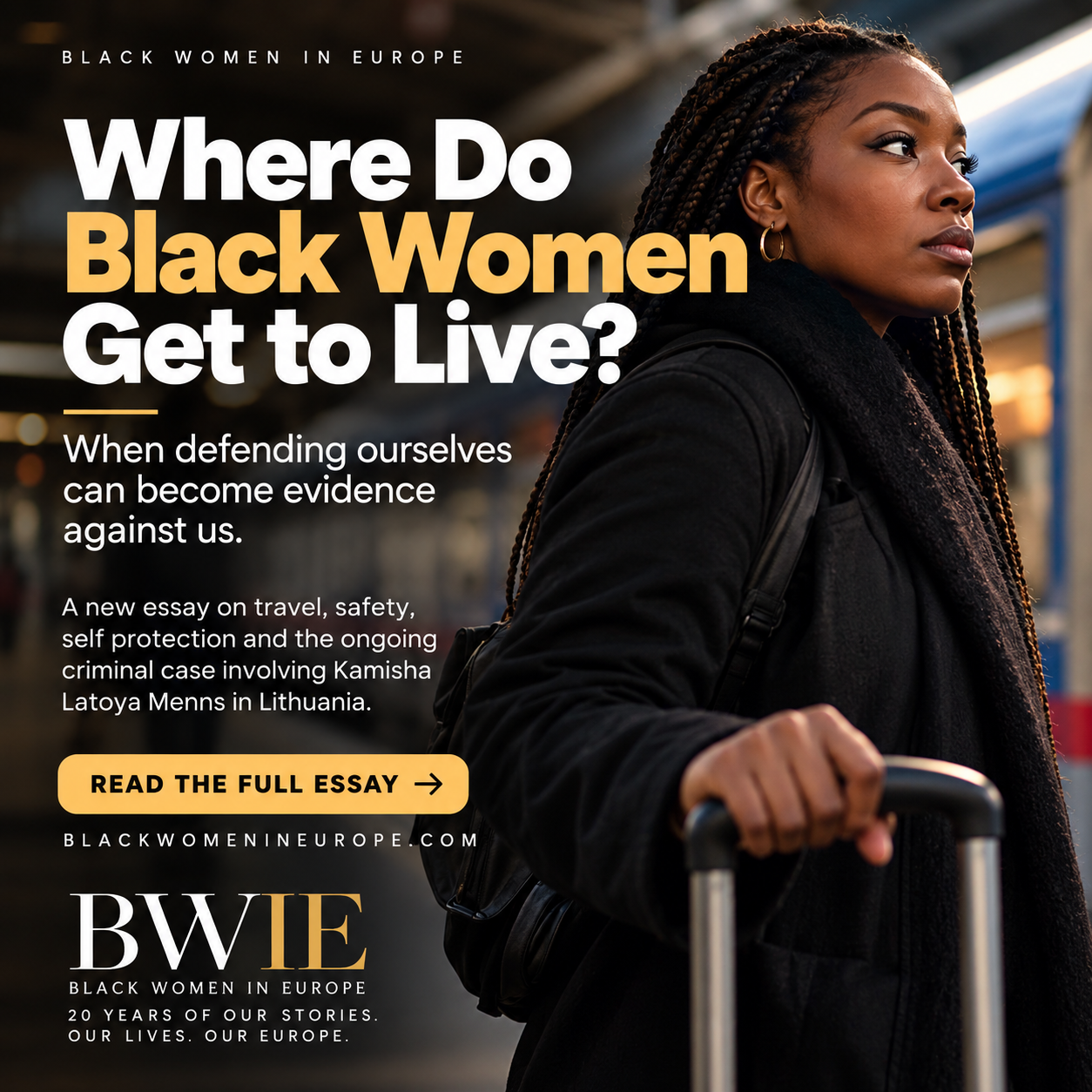
When defending ourselves can become evidence against us
A note on the law behind this essay
This essay is written with Lithuanian, European, Swedish and United States law in mind. That sentence matters. Black Women in Europe has spent 20 years telling the stories of Black women living across this continent. But telling the stories of our lives can become complicated when those stories cross countries, legal systems and ideas about what people may say publicly.
Lithuania protects freedom of expression under Article 25 of its Constitution. The Constitution protects the right to hold and express convictions and to seek, receive and impart information and ideas. It also permits restrictions established by law to protect health, honour, dignity, privacy, morals and constitutional order. It specifically says freedom of expression is incompatible with criminal incitement to hatred, violence or discrimination, as well as defamation and disinformation. Source: Constitution of the Republic of Lithuania, Article 25.
At the European level, there are two important protections. Article 10 of the European Convention on Human Rights, which comes from the Council of Europe, protects the freedom to hold opinions and to receive and impart information and ideas regardless of borders. That freedom can be restricted under circumstances prescribed by law and necessary in a democratic society, including protection of the reputation and rights of others.
Article 11 of the EU Charter of Fundamental Rights also protects freedom of expression and information, including the freedom to receive and impart information and ideas without interference by public authority and regardless of frontiers. I live and publish in Sweden.
Sweden’s constitutional system strongly protects freedom of expression. The Instrument of Government protects expression and information in relation to public institutions, while the Freedom of the Press Act and Fundamental Law on Freedom of Expression provide additional constitutional rules for media that fall within their scope. Not every ordinary website automatically receives all of those special media protections.
Sweden also implemented EU rules intended to provide safeguards in certain cross border civil proceedings involving participation in public debate. The rules concern what are sometimes called SLAPP cases: strategic lawsuits against public participation. The Swedish implementation was designed to apply to certain cross border civil disputes involving statements on matters of public interest. And I am American. The First Amendment to the United States Constitution protects freedom of speech and of the press against government abridgment in the United States.
But being American does not mean I carry the First Amendment around Europe like a force field. Different country. Different jurisdiction. Different law. Different limits. Which, frankly, is part of the point of this essay. Sometimes even telling the story requires a risk assessment.
I have started doing risk assessments for freedom
Before I share what is happening to another Black woman, I calculate. What can I verify? What is her account? What has been independently reported? What remains disputed? What happens if I speak? What happens if somebody decides my criticism is itself the offense? Then there is another risk assessment. Travel. Where am I going? What happens if someone confronts me? What happens if someone touches me? What happens if I say no? What happens if I defend myself? And lately I have wondered whether saying every time I travel is even accurate. Perhaps I mean every time I leave the house. Because I know what it is like for an ordinary day to suddenly become something else. I was assaulted on an airplane.
Assaulted on the plane — My workation got off to a rocky start
I was harassed at a shop near a train station.
What do you do when harassed at the shop near the train station?
I documented both experiences. But following what is happening to Kamisha Latoya Menns in Lithuania has forced me to ask a different question. What if I had defended myself? Not attacked anyone. Defended myself. What if I had pushed a hand away? Raised my voice? Refused to move? Demanded that someone stop? Gotten angry? What if the person confronting me then said she was frightened? At what point does a Black woman protecting herself become the person everyone else needs protection from?
A Black mother takes her daughter skiing
Kamisha Latoya Menns is a Belgian and Jamaican citizen living in Lithuania. Public professional records identify her as a lawyer, and she publicly describes herself as a shop owner, migrant, lawyer and mother.
Her current criminal case arose from a February 2025 incident at the Liepkalnis ski centre in Vilnius. Menns says she brought her then 11 year old daughter for a skiing lesson. She says they were initially refused service. She says she was subsequently charged twice for her daughter’s ticket. She says the confrontation escalated when she requested a refund.
Lithuanian reporting presents those statements as Menns’s account. That reporting also records Menns saying that the ski centre later refunded the additional ticket. Prosecutors describe the incident differently.
Current Lithuanian reporting says Menns is being prosecuted over alleged violation of public order and alleged incitement against a group based on characteristics including race, skin colour and sex.
Menns denies guilt. That distinction matters.
Menns says. Prosecutors allege. The court decides.
I am not sitting in that courtroom. I am not deciding whether Kamisha Menns committed a Lithuanian crime. I am watching what her case raises for me as a Black woman.
“Insolence to a White woman”
Menns has characterized what is happening to her as effectively being prosecuted for “insolence to a White woman.”
Those are her words and her interpretation. “Insolence to a White woman” is not the formal name of a Lithuanian criminal charge. Menns herself says the criminal case involves Section 170(2) and Section 284 of Lithuania’s Criminal Code, concerning alleged incitement and public order. Independent Lithuanian reporting similarly describes the case as involving public order and alleged incitement against people based on characteristics including race and skin colour.
But I cannot dismiss the question underneath her choice of words. What happens when a Black woman says she was responding to mistreatment while the state alleges that her response crossed into criminal conduct? What happens when the response becomes bigger than whatever caused it? And what happens when fear enters the room?
Who gets to be afraid?
A September 16 Instagram post from Menns stopped me.
In that post, Menns says that an alleged victim testifying in the criminal trial said she felt powerless as a White woman and that the experience made her cry and have a panic attack.
That is Menns’s published account of the testimony. I have not independently reviewed an official court transcript containing those exact words. Menns responded publicly by describing what she says were the circumstances around them. She says she and her 11 year old daughter were the only Black people present.
She says the employee had colleagues, several men and police nearby. Menns also says that video evidence contradicts allegations that she pushed employees. Those are Menns’s assertions about the evidence. Whether the recordings establish what Menns says they establish is for the court evaluating the evidence. My question is different.
Whose fear changes what happens next? Whose fear gets understood immediately? Whose fear summons protection? Whose raised voice becomes threatening? Whose anger becomes evidence? Whose tears become part of the case?
And when two people both say they were afraid, how does power affect whose fear institutions understand first? I do not need to declare anyone guilty of racism to ask that question.
America gives me no easy answer
I keep thinking about Congresswoman LaMonica McIver.
In May 2025, McIver was at the Delaney Hall immigration detention facility in New Jersey as part of a congressional oversight visit. A confrontation developed involving federal officers. Federal prosecutors charged McIver over alleged interference with officers. McIver challenged the prosecution, including through arguments that the prosecution was selective and vindictive.
That does not establish that her prosecution was racially motivated. And I am not claiming that it does. What interests me is the broader question.
A Black woman was exercising authority she understood herself to possess as a member of Congress. The resulting dispute became, in part, about where protected governmental activity ended and allegedly criminal interference began. That gives me another version of my question:
How does a Black woman know when the authority she believes she is exercising will be interpreted as interference instead?
Different case. Different facts. Different law.
Same uncomfortable question about who gets to act.
And then there are the women who said they were protecting themselves
Consider Siwatu Salama Ra. During a confrontation outside her mother’s Detroit home, Ra displayed an unloaded firearm. Evidence at trial included testimony supporting her contention that another woman had driven a vehicle toward members of Ra’s family. Ra was convicted.
The Michigan Court of Appeals later reversed her convictions because the jury should have received an instruction allowing it to consider nondeadly self defense. The appellate court concluded that evidence existed from which a jury could find that displaying the firearm was intended to protect herself or others against an imminent unlawful use of force.
Then there is Marissa Alexander. Alexander fired what she described as a warning shot during a confrontation with her estranged husband. Nobody was struck. She was convicted of aggravated assault and initially sentenced to 20 years. A Florida appellate court later reversed the conviction because of erroneous jury instructions involving self defense.
I am not saying these cases prove that every Black woman who invokes self defense was treated unfairly because of race. They do not. I am saying they give me reason to keep asking the question.
When do Black women get to defend ourselves?
Because I have had to ask myself the same thing
When I watch the video from that airplane now, another layer appears. What if I had reacted differently? What if I had pushed back? What if I had shouted? What if somebody had begun recording only after I reacted? What if the video began with my response instead of what happened to me first?
What would you see? A woman defending herself? An angry Black woman? A threat? What would the police see if they arrived at that moment?
When I think about being harassed at the shop near the train station, I can ask the same questions.
What if I had refused to move? What if I had matched somebody else’s volume? What if I had put my hands up to protect my body? Would the story still have been about what happened to me?
Or would the story suddenly become:
What did she do about it?
That is a different kind of vulnerability. You do not only assess the threat. You assess your response to the threat.
Can I speak? How loudly? Can I say no? How firmly? Do I document this? Do I call the police? Will calling the police help? Do I walk away? Can I safely walk away? If I defend myself, what will people see?
At what point does a travel risk assessment become a leaving the house risk assessment?
That question bothers me. Because I travel. I live in Europe. I move between cultures. I speak publicly. I publish. I question things.
And I am a Black woman.
I do not get to assume that being educated, accomplished, visible, professional, a citizen somewhere, or even a lawyer or elected official will spare a woman from having to make calculations about what happens when a situation goes wrong.
And apparently even writing about those calculations requires another calculation. I wanted to write this article. Then I stopped. I researched Lithuanian law. European speech protections. Swedish law. American protections. Cross border publication. Defamation.
Why? Because being brave requires being careful.
This is how stress keeps showing up
This is where Kamisha Menns’s case, my experiences and the work I do around stress meet. Stress is not always a calendar with too many appointments. It is not always the job. It is not always money. Sometimes stress sounds like this:
Am I safe? Should I say something? Should I leave? Should I document this? Should I call someone? Can I defend myself? What happens to me if I do?
And sometimes: Can I tell people what happened afterward? That is a lot for a nervous system to carry.
Research from the European Union Agency for Fundamental Rights has documented substantial experiences of racial discrimination and racist harassment among people of African descent across the EU countries it surveyed.
Lithuania was not included in that particular survey. So those figures should not be used as statistics about Lithuania. They belong to a larger conversation about how people of African descent describe navigating life in Europe.
Where do Black women get to live?
That is the question I cannot shake. Where can we travel without preparing to prove what happened to us later? Where can we live without someone suggesting that perhaps we should simply go somewhere else if racism troubles us? Where can we become angry without our anger swallowing the original harm?
Where can we protect ourselves without first calculating whether our protection will frighten someone who has greater institutional power? Where can a Black mother advocate for her child? Where can a Black woman say:
No. You will not do this to me.
And remain the person entitled to protection? I do not want safety that requires silence. I do not want freedom that depends on being agreeable while someone crosses my boundaries. I do not want to spend the rest of my life calculating the acceptable volume of my own self protection.
And I refuse the idea that the solution to racism is for Black women to spend our lives searching for somewhere else to exist. There has to be room for us here. In Lithuania. In Sweden. In the United States.
On airplanes. In shops. At borders. At work. At home. Inside government buildings. At ski centres. On the street.
Not because we always respond perfectly. Not because we never become angry. Not because we must demonstrate perfect behaviour before becoming worthy of protection.
But because personal freedom means very little when exercising it requires a risk assessment.
Why Stress Keeps Showing Up
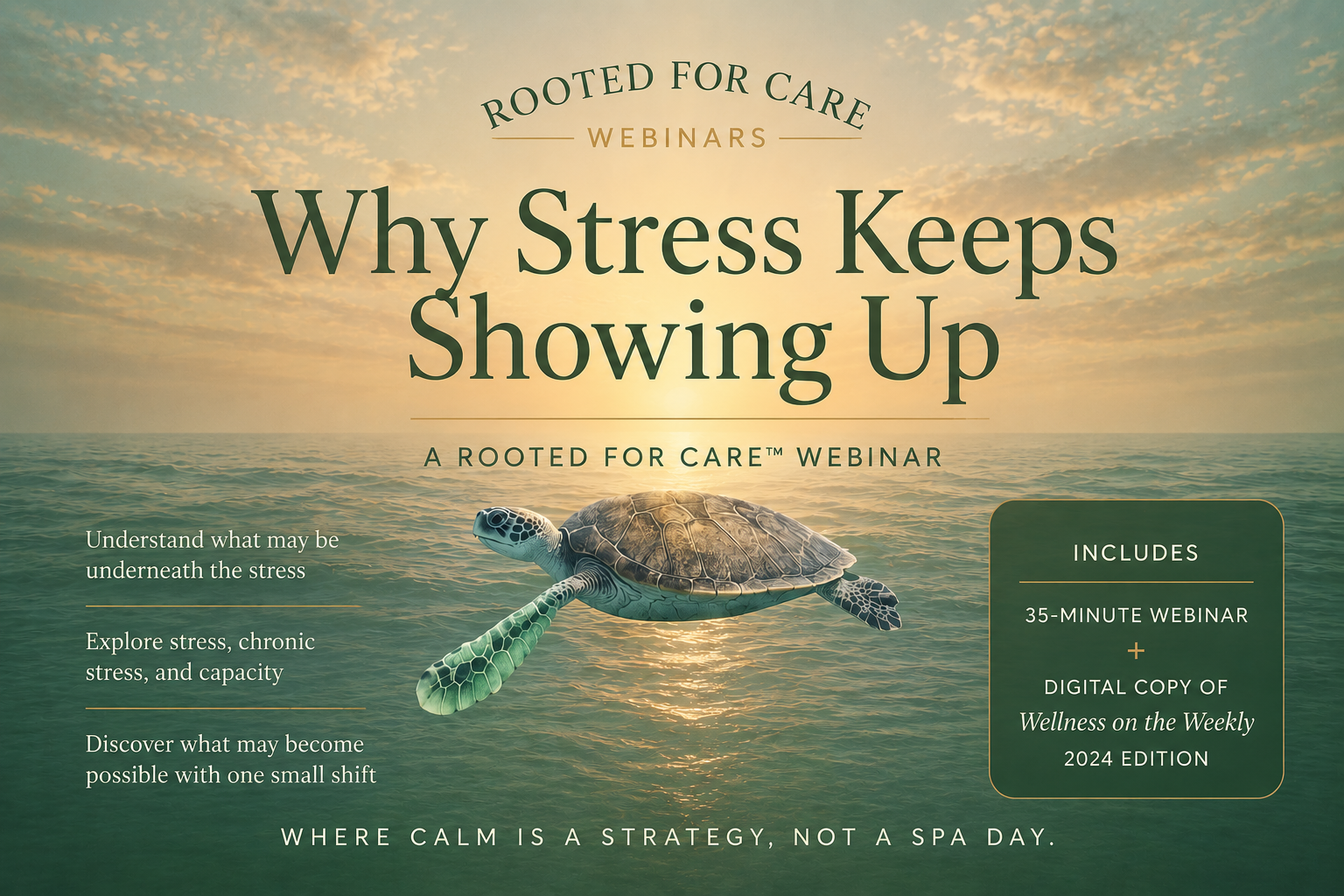
And this is exactly why I created Why Stress Keeps Showing Up.
Sometimes your body is not responding only to what is happening today.
It is responding to a collection of moments when an ordinary situation changed quickly and you had to decide whether to speak, leave, stay quiet, protect yourself, document what happened, or prepare for what might happen next.
Those patterns can follow us.
My 35 minute Why Stress Keeps Showing Up webinar helps you recognize those patterns and begin interrupting them.
Your $19.95 registration includes the webinar, a digital copy of Wellness on the Weekly: 52 Fun Prompts for Mindfulness, Movement, and a Whole Lot Less Stress!, a Patterns Assessment, and an opportunity to unpack your results.
Because calm is not pretending difficult things never happened. Sometimes calm begins with understanding what your mind and body learned while trying to keep you safe.
Why I am writing this
I could have simply shared Kamisha Menns’s posts. That would have been easier. Instead, I started asking questions. About her. About myself. About Lithuania. About America. About Sweden. About the law. About race. About fear. About the difference between an act and a reaction.
About what happens when the woman defending herself becomes the woman being scrutinized. And perhaps most importantly:
What price are Black women expected to pay for personal freedom?
I want other Black women living in Europe in this conversation. Not because we must agree about every fact, every interpretation or every legal argument. We should not.
The Black Women in Europe Blog and ecosystem exists because our lives here deserve to be documented while we are living them. For 20 years, that has been our work.
Silence is also a decision. And for me, silence comes with its own risk assessment. I have decided that particular risk costs too much.
Where do Black women get to live? And once we get there: When do we get to defend ourselves?
